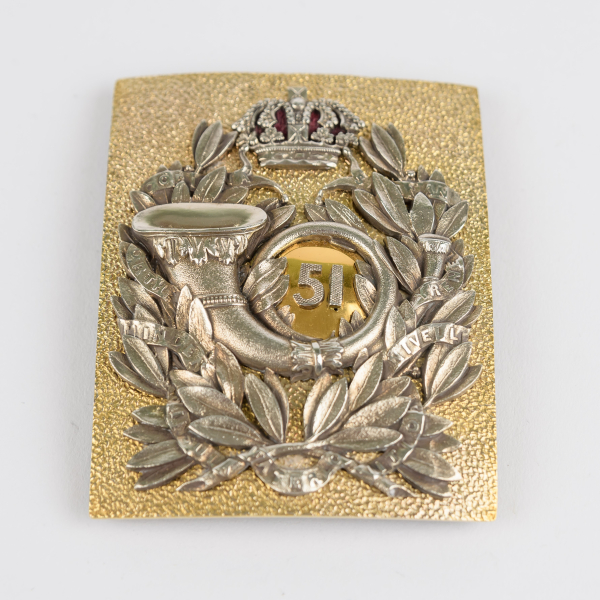
The 51st Foot (Kings Own Yorkshire Light Infantry) Officers Shoulder Belt Plate circa 1840-1855. A superb plate with reeded gilt backplate, on this a silver laurel wreath with Peninsular War Battle Honours - to the centre a bugle horn to the centre on plain gilt the Numerals 51, to the top a Guelphic Crown over a red backing - a real beauty.
Equivalent to an auction hammer price of £999 plus c.£300 commission — but with Collexchange, you pay no commission at all!
Regiment: 51st (2nd Yorkshire West Riding) Regiment of Foot — later became The King’s Own Yorkshire Light Infantry (KOYLI).
Object: Officer's Shoulder Belt Plate
Date: Circa 1840–1855
Type: Shoulder belt plate (worn across the chest on the crossbelt)
Period: Pre-Cardwell Reforms (pre-1870s)
Design Features:
Gilt Backplate: Reeded and textured gold ground — standard for officers’ dress of the time.
Silver Laurel Wreath: Surrounding the central elements, signifying honour and victory.
Bugle Horn: Classic light infantry symbol, centrally placed — denoting their role as light infantry, which prized speed, agility, and skirmishing ability.
Number "51": Prominently displayed in gilt inside the bugle — the regimental number.
Battle Honours: Displayed on the wreath — these commemorate Peninsular War victories.
Guelphic Crown: Used in British military insignia during the reign of King George IV and King William IV, placing this between 1820–1837 in origin, though many regiments retained it into the 1850s.
Red Backing: Behind the crown — adds contrast and prestige to the crown insignia.
Historical Context:
The 51st Foot saw extensive service in the Napoleonic Wars, particularly in the Peninsular Campaign under Wellington. Their conversion to light infantry gave them a distinct identity, reflected in the bugle and their fast-moving, flexible combat role.
The badge captures the height of Victorian regimental identity before the sweeping reforms of the 1870s-1880s which reorganized the army structure.
A shoulder belt plate like this would have been worn on full dress parade, typically mounted to a white leather crossbelt.